Submitted by Mari Page
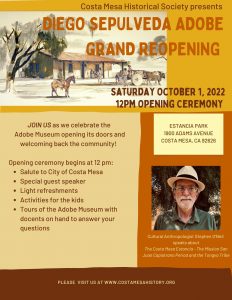
Living in California most of us have seen structures of adobe built by the Spanish colonists and early settlers in some of our cities. Costa Mesa has one of these adobes, the Diego Sepulveda Adobe that is located in Estancia Park.
Adobe did not originate with the Spanish settlers. It has long been used by man to build with. Archaeologist have found adobe mud blocks dating back to at least 8,000 BC in Asia. Adobe construction was and is still used in China, India, and other dry areas of Asia.
In Northern Peru, in the Andes, there is evidence of an adobe structure that is over 5,000 years old. The adobe bricks were cut from natural clay deposits. Similar building techniques were used, and advancements were made in construction, throughout the Andes region of South America.
Adobe as a building material has been used over a large geographical area of the world. In fact, even today, 30% of all of the world’s population and 50% of the population in developing countries, are living in homes that are constructed from the earth.
In the early sixteenth century the first Spanish settlers and missionaries started arriving in the southwest bringing with them their technique of adobe brick making. The Spanish were not the first to use adobe to construct their homes in the Southwest. The Native Americans cliff dwellers the Anasazi, who lived in what is now the Four Corner area of the United States, used an adobe clay mixed with stones to build their cliff dwellings.
In areas that lacked wood and other building materials adobe was often easily accessible and construction with it was almost free excluding labor. The important key for success in using adobe and other types earthenware construction is a dry climate which made arid Southwest a good place for building with these bricks. Clay was reinforced by mixing it with water, straw, grass and animal manure to strengthen it and improve it’s durability.
Another benefit of adobe construction in these warm, and usually sunny, climates was its insulating properties, keeping the structure cool by absorbing the heat during the day. During the night the stored heat would be released warming the area.



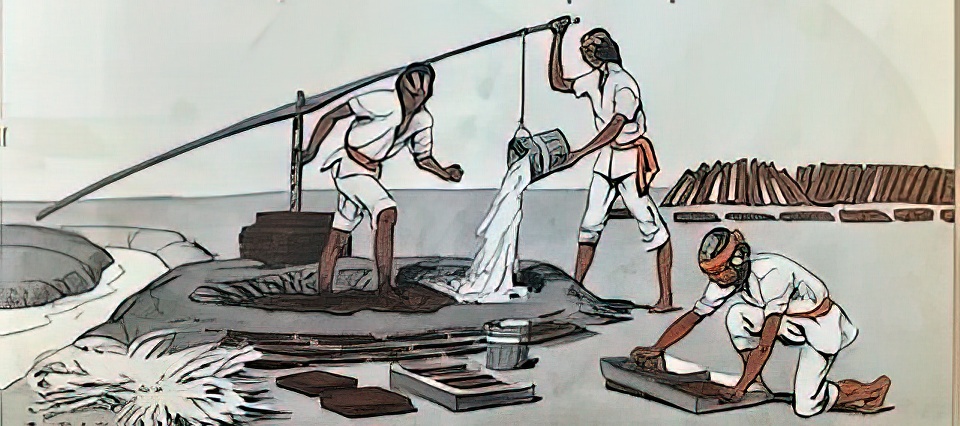
The construction of adobe bricks was a very labor intensive process in California. It required many workers to make the bricks, dry them and then stack them into the walls of the structure. The workers would first have to dig a hole in the ground in a bowl shape where the clay for the adobe would be pounded to remove lumps. Water and small pieces of straw, grass or manure would then be added and stirred together by tramping on the mixture with bare feet. The mud mixture would be placed in wooden frames. When the mixture was partly dry, the form was lifted. The adobe mud bricks were set on edge in the sun to dry until they were hard. Picture showing the general process workers used to make the adobe bricks. 5 A dobe bricks—continued
After the bricks were dry, construction on the building could occur. The bricks were laid in rows, one row on top of another row. The walls of the building were from two to three feet thick. It took thousands of dried adobe bricks to build one small structure. After the building was completed and roofed, the walls were covered with a plaster made of lime. Lime was obtained from sea shells or limestone that was crushed. The builders would lay the broken limestone rock or sea shells on a slow burning fire and cover the fire with dirt. This baking process produced quicklime which was mixed with water, sand, and hair to make a plaster to cover the walls. When the plaster dried it protected the walls from rain and disintegrating from the moisture.
Our Diego Sepulveda Adobe in Estancia Park has under gone many transformations and repairs in it’s history. In 1963, the Segerstrom family donated the adobe and a five acre site to the City of Costa Mesa, under the condition that it would be a museum where its history would be told. Many studies and plans were made working towards the adobe’s reconstruction. In 1965, plans were finalized and reconstruction happened. The total cost at that time was approximately $28,000. Inside the Adobe one of the original bricks is on display. We are fortunate to have an example of this important type of architecture from California’s early history in Costa Mesa to see and visit.
Visit the historical Diego Sepulveda adobe in Costa Mesa